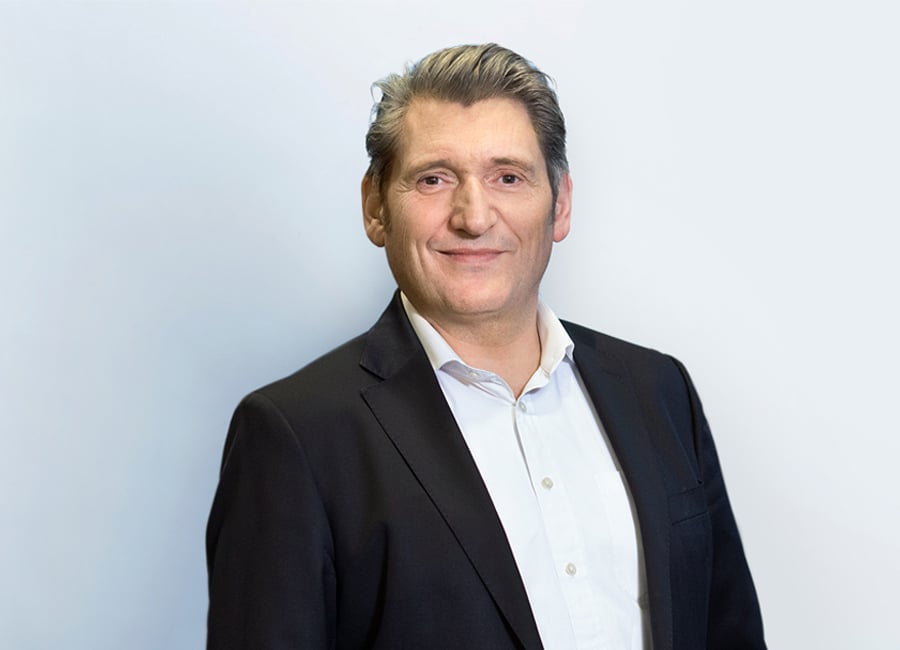
For Franz A. Wenzel, Managing Director USA, the last five months in Anderson, South Carolina have felt like an entire year. Born, raised, and educated in the US, our consultant has returned to the US after nearly two decades abroad in both Germany and Europe, at large—as a consultant for German SMEs in the Upstate boom. What are his impressions after five months in the southeastern US? Has his focus shifted? And what questions does he frequently encounter from German companies expanding into the US? From risks to future prospects: an honest, personal, and practical insight.
Mr. Wenzel, your LinkedIn banner motto is “Take risks now & do something bold: You won’t regret it”: What risk did you take in the US? And what do you not regret after five months in Anderson?
For me, the risk wasn’t taking on the responsibility at all. I have absolutely no problem with that. When I make decisions, I stand by them—period. And if things don’t work out, then you just have to face the consequences. The real step was something else: I came over from a functioning system. In Germany, I was part of an organization with structure, a network, and a reputation. Everything was running smoothly. And then you find yourself in one of the largest and, at the same time, most competitive economies in the world. After all, the US is a 31 trillion dollar economy—and then there you are, sitting in an empty office with very low brand awareness. It’s a reality check. What I don’t regret at all after five months is precisely this step. It forces me to be very clear about my own value and about how to position a company and myself in a new market. Starting from zero is uncomfortable—but it is incredibly clarifying.
Anyone who knows you knows: your focus is on technology, transformation, and turnarounds. Has your mandate changed significantly?
The core has remained the same: transformation, operational improvements, turnaround situations. What has changed is the context: when you work in the US, you automatically become, to some extent, a translator between two business cultures. You help German companies understand how the American market works, and at the same time, you reflect American reality back to the German organization. In our case, it’s important to know: Germany is South Carolina’s most important export partner. For 2025, the state reported $5.1 billion in export revenue to Germany. South Carolina is now home to over 1,100 international companies, around 270 of which are from Germany. These German companies, in turn, employ more than 44,000 people here.
How does that show up in your everyday life?
You really run into Germans and other Europeans everywhere here. Not just at networking events, but day in and day out—at restaurants, in hotels, in conversations with suppliers. Many, like me, have already spent ten, 15, or 20 years in the US. I remember a situation at a social event in Greenville: We were standing together in a small group, and at some point the question came up: “Which visa brought you here?” Everyone had a different story—L-1, E-2, Green Card, H-1B, transfer from Europe. I was one of two with dual citizenship. So, these conversations are completely normal here. And this shared experience of having taken this step automatically creates a connection.
What do you observe in the Southeast that German SMEs often overlook?
The Southeastern region of the US is far more than just a region with low costs and plenty of space—it has developed into a highly professional, extremely competitive, and internationally networked economic region. Many German SMEs often underestimate this or view it too one-sidedly.
Many initially focus heavily on labor costs, tax advantages, and land availability. They assume there is relatively little competition. That is a classic fallacy, because in reality they are entering a region with stable, highly developed supply chains, experienced management, and intense competition—especially for qualified talent. It is an active, globally oriented market. We already knew before we set up shop that the South is booming, economically well-developed, and offers attractive conditions. But what surprised us all was the scale of this development: the density of global industry clusters, the professional structures, and the pronounced international character.
That’s why our first US branch is in Anderson, South Carolina.
Yes, it is deliberately located in the center of the I-85 corridor between Atlanta and Charlotte—one of America’s most dynamic industrial hubs. From here, I’ve been on the road nonstop over the past few months: from Texas through Louisiana to Alabama, Georgia, Tennessee, North Carolina, and Florida. I’ve also made visits to New York. Everywhere you go, you encounter established German and international companies. The Southeast is continuing to attract massive foreign investment and is at the forefront of many manufacturing and reshoring projects. Established examples include BMW in Spartanburg with its largest plant worldwide, over 11,000 employees, and enormous exports. Then there’s Mercedes-Benz in Alabama and Volkswagen in Tennessee. The Port of Savannah in Georgia had one of its strongest years in 2025 and provides the region with excellent global connectivity.
You know the US very well; you were born, raised, and educated here. What surprised you upon returning?
How professional and international the entire southern United States has become. I hadn’t quite expected that, even though I was aware of the boom. We had anticipated the development and internationalization, but the actual degree of modernity, professional structures, and global connectivity is immense. It is a highly developed economic region that is not only growing but is competing at a world-class level. Viewed from the outside, the South sometimes still seems regionally defined, but economically it is highly globalized, with dense industrial networks. What stands out is the strong presence of German and European companies in the automotive, mechanical engineering, metal, and logistics sectors: truly exciting ecosystems are emerging in which German firms, European suppliers, and American partners work together seamlessly. That’s what makes the region so vibrant and resilient.
What questions do German companies expanding abroad ask you most frequently about relocation? How do you respond?
The questions are surprisingly consistent. First: How quickly can we become operational here? Second: How do we attract top talent? Third: Is the business case really sound? And eventually, the crucial question arises: What actually happens to our customers when we relocate? Many calculate their production costs very precisely, but underestimate issues like ramp-up risks, customer trust, and delivery capability. I recently had a conversation with an automotive supplier who had calculated his production costs very accurately. What he hadn’t factored in was a 12- to 18-month ramp-up phase during which quality, processes, and supply chains need to be further reiterated and stabilized. My response is often quite direct: “The US market is very forgiving of bold moves—but not of operational chaos.” It’s true. Companies that come to the US have to deliver.
What are relocating companies most concerned about?
Surprisingly rarely about technology. The biggest concerns are usually these three: resources, delivery capability, and cost reality. The issue of resources—skilled workers and labor—is often underestimated. The unemployment rate in Upstate is currently well below 6% and signals a tight labor market, but not full employment in the strict sense. This means: Qualified workers are available, but they can choose their employers. That’s why I often say: The most important investment in the US isn’t in buildings; the best investment is in people.
Highlights of German companies on the ground: What do you observe?
German companies often have a very good reputation here in the South—especially when they combine their technical strengths with local leadership. This good reputation also has historical roots: Companies like BMW, Bosch, and ZF have been active here for decades and have built very stable structures. For example, BMW Spartanburg remains a symbol of how deeply German industry is rooted here: In 2024, the plant was once again the largest automotive exporter in the US by export value, with around 225,000 vehicles exported and an export value of over $10 billion. Such investments shape the landscape. Many German companies are building for the long term here—not with the mindset of “Let’s give this a try,” but rather: “We’ve come to stay.” That builds trust.
Is 2026 a good time for US expansion—despite new tariffs and geopolitical uncertainties?The reality of the 15% tariff is no minor issue. Under the US-EU trade agreement finalized in 2025, new conditions apply to many EU goods: For cars and parts, the tariff rate was reduced from 27.5% to 15%, but it remains significantly higher than before. This changes business cases, but does not automatically end them.
Why I still see 2026 as a good time for many companies to expand into the US: Especially when it comes to Upstate SC, it will continue to have industrial momentum. In 2025 alone, South Carolina reported $38.5 billion in exports—the highest level in seven years. The state holds an 18% share of the US market for exported passenger cars, and Germany remains its most important export partner. At the same time, Upstate has strong logistical connections, including via Savannah. In 2025, 545,214 containers were moved by rail through the Port of Savannah, supported by 39 weekly container services. So, yes: 2026 is a good time for US expansion when it comes to market and customer proximity, resilience, and operational presence—but not if companies are only looking to engage in labor cost arbitrage.
Of course, many companies are currently increasingly concerned about how geopolitical risks are developing overall. A look at the Middle East, particularly around Iran, makes it clear how quickly global supply chains can come under pressure. Energy prices, transport routes, political tensions: all of this has a direct impact on industrial companies. This is precisely why many firms have long since ceased to view the US market merely as a sales market, but also as a strategic component of stability. When companies set up their production and supply chains closer to the market, their business model becomes more resilient. I think for many companies, the question is no longer whether, but when and how they will expand into the US.
“Business Consulting is a People Business”: Is that very different in the US compared to Germany?
In Germany, trust is often built through depth and structure. In the US, trust often develops more quickly—but it disappears just as fast if you don’t deliver. Here you hear more often: “Okay, sounds good. When can you start?” That’s more direct, and I find it very refreshing. But in the end, you need both: German structure and American speed.
What professional takeaway from your time in Germany is helping you the most right now?Definitely structure under pressure. Germany taught me to analyze and structure complex situations clearly. That helps enormously when you have to make quick decisions in the US. Or to put it another way: Speed without structure is noise. Speed without structure gets you nowhere. But neither does structure without speed.
What has been your biggest challenge so far—and your most important lesson?
The balance between two worlds. You shouldn’t romanticize the US or underestimate Germany. Both systems have enormous strengths—and their blind spots as well. My biggest lesson after five months is probably this: You have to make decisions much faster here, but without getting frantic in the process.
Looking ahead: How are you evolving—and what does that mean for enomyc USA?
I’m driven by building something substantial. Not just a nice US story, but a company that independently wins contracts, implements projects, and helps both German and American companies succeed here. For enomyc USA, that means deepening networks, continuing to build initial references, and strengthening partnerships. We’re just getting started, and that’s exactly what makes it so exciting. In conclusion, I’d say: The US market rewards courage—but above all, it rewards those who deliver.
Thank you very much for the candid conversation, Mr. Wenzel.