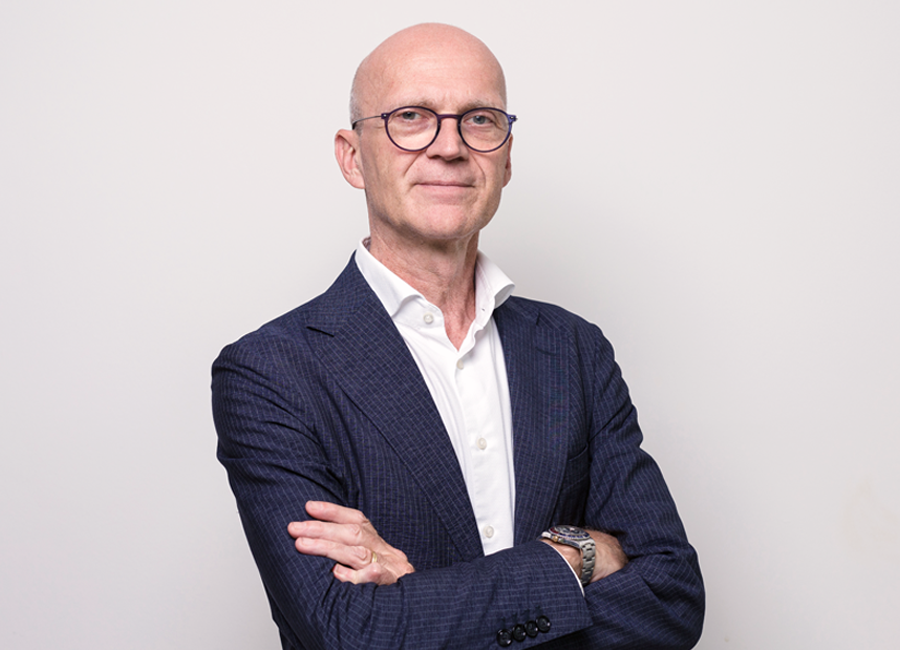
What drives companies into crisis and what does it take to overcome it? Last year, enomyc surveyed around 200 financing experts from Germany on this topic. One of the most important findings was that many medium-sized companies shy away from taking a hard look at their current situation. As a result, they overlook warning signs and clues that should make them sit up and take notice. We spoke with enomyc strategist and consultant Dr. Stefan Frings about what these might be and how companies can best position themselves now.
HDr. Frings, for your study last summer, you spoke with financiers from the areas of restructuring, intensive care, and corporate support. Do you think the results would be very different today?
Dr. Stefan Frings: No. The significant crisis that many respondents saw in the German economy last year has actually worsened.
For example, we are seeing that demand in many industries is hardly recovering. Even the most conservative sales plans are currently difficult to achieve. This is due to economic reasons, but it is also strongly related to massive competition from Asia. In addition, entire industries are losing customers, such as the automotive industry. Geopolitical uncertainty, which respondents in the study cited as a major obstacle to growth, has also increased rather than decreased.
What has changed since our survey last year is that the time window for restructuring has become much shorter. A considerable proportion of the companies we are dealing with today can no longer be restructured. The only option left is liquidation – often because they waited too long and did not take comprehensive enough countermeasures.
How can countermeasures be taken in such a situation? Is it possible to save your way out of the crisis?
Dr. Stefan Frings: No, saving alone is not enough. Companies also need growth. However, this has become difficult because it is almost impossible to generate growth in the domestic market. And small and medium-sized enterprises that want to tap into new sales markets abroad often face the problem that they cannot find anyone who has the courage to finance these investments.
Then they have to look for alternative sources of funding...
Dr. Stefan Frings: Exactly. The task is to find additional investors and equity providers at an early stage. That's why we involve our debt advisory experts in the preparation of expert reports, for example, to examine where and how additional funds can be activated if necessary.
Nevertheless, in the end, there is often no way around a sale...
Dr. Stefan Frings: That's right. But even an M&A process should be initiated as early as possible, while business operations are still ongoing and customer relationships are intact. If at all possible, a sale should take place outside of insolvency. This is another argument in favor of early action.
Many financiers criticized the inadequate commercial management in many medium-sized companies in the study...
Dr. Stefan Frings: This is an extremely important issue – and still a massive problem. Even many larger companies are managed in a commercially disastrous manner. The issue still does not have the importance it should have today. We repeatedly find that there is a shortage of strong CFOs in medium-sized companies in particular who think clearly ahead, know the relevant planning tools, can draw up solid liquidity plans and adjust them during the year. This has fatal consequences in crisis situations. Among other things, it means that financiers do not get the figures they need. Or they get them late, incomplete or incorrect.
Can we go so far as to talk about a comeback for the CFO?
Dr. Stefan Frings: Absolutely.
According to financiers, one of the most important factors for successful restructuring is the willingness to implement painful measures quickly and consistently. Many still seem to find this difficult.
Dr. Stefan Frings: Most of the obvious cost-cutting measures have long since been implemented in companies. Now it's a matter of taking more significant structural measures, such as divesting unprofitable business areas. These are complex decisions that require appropriate preparatory work and coordination with each individual customer – and, of course, with the financiers. Divesting unprofitable areas is a decision with far-reaching consequences, but unfortunately it is unavoidable in a crisis.
What proposals for structural measures and deep cuts are still on your list?
Dr. Stefan Frings: There are quite a few. Companies urgently need to start consistently digitizing their processes, relying on artificial intelligence, merging plants, or making cuts in personnel – including management, by the way.
It is no coincidence that the topic of overhead is currently experiencing a renaissance. Shared service centers are also very popular at the moment because companies have realized that they can save a lot of money by relocating not only their production but also indirect functions abroad. This is particularly useful for highly repetitive tasks such as payroll accounting or bookkeeping functions. Serbia is currently a very popular location.
How do entrepreneurs know that they need to take action, i.e., that they really need to tackle the uncomfortable measures now?
Dr. Stefan Frings: A typical early warning sign is the gradual loss of market share and sales. For example, we had a customer with a good product. They were well positioned for a long time, but then slowly lost one customer here and then another there. At some point, the loss was so great that the company could no longer be saved. If those responsible had reacted earlier, something could certainly have been done.
Given these difficult conditions, is there still any chance of new growth for companies?
Dr. Stefan Frings: Growth prospects are certainly very limited in the domestic market. That's why small and medium-sized enterprises need an intelligent internationalization strategy. The Mercosur agreement is a ray of hope in this regard. However, in my opinion, companies must generally prepare themselves for low sales levels in the future. Growth is now practically only possible through displacement. This makes it all the more important to lower the break-even point now—among other things, by reducing fixed costs.
Dr. Frings, thank you very much for talking to us.